

Why do we need to amend the Marine Mammal Protection Act (MMPA) to protect salmon?
Unregulated seal and sea lion predation threatens to undermine investments in salmon recovery. The Northwest Endangered Salmon Predation Prevention Act of 2026 (HR 9621) offers a solution.
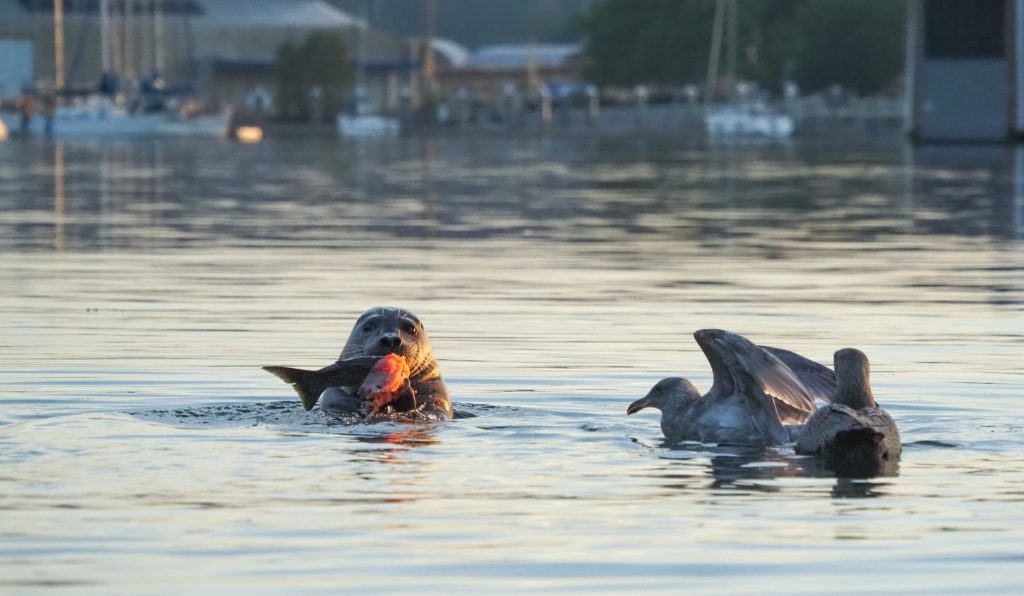
Predation on salmon by seals and sea lions represents an unregulated and unpredictable fishery.
- Pinnipeds likely take more salmon than all fisheries (sport, commercial, and tribal) combined in Puget Sound.
- They outcompete critically endangered southern resident orca for prey.
- Recovery of salmon and orcas will not be possible without controlling total mortality on salmon stocks.
Seals and sea lions can consume significant portions of individual runs.
- Harbor seals consume up to 33% of the Nisqually Steelhead migrating out to sea.
- Sea lions consume up to 43% of the spring Chinook salmon coming into the Columbia to spawn.
Already declining salmon runs can’t sustain this level of predation.
- Puget Sound Chinook, Hood Canal Summer Chum, and Steelhead are listed as threatened under the Endangered Species Act (ESA).
- Coastal Chinook and Steelhead were recently petitioned for listing under the ESA.
- Coho, Sockeye, and Chum stocks that are not listed are experiencing severe declines.
Harbor seal populations have reached carrying capacity and populations of California and Steller sea lions continue to increase unchecked.
The MMPA already authorizes states to apply for permits to lethally remove individually identifiable, predatory pinnipeds that are having a significant negative impact on salmon and steelhead listed under the Endangered Species Act as well as stocks approaching a listed condition or that are migrating through Ballard Locks.
- Due to the burdensome administrative process of identifying and marking an individual problem pinniped, applying for and issuing a permit, this provision has rarely been used and never outside of the Columbia River.
- A 2018 provision allows the states of Washington, Oregon and Idaho, along with the Nez Perce Tribe, the Confederated Tribes of the Umatilla Indian Reservation, the Confederated Tribes of the Warm Springs Reservation of Oregon, and the Confederated Tribes and Bands of the Yakama Nation to take sea lions near Bonneville Dam to protect listed stocks.
- California sea lions, Steller sea lions and harbor seals are having a negative impact on salmon recovery across the region, not just near Bonneville Dam.
Non-lethal deterrents do not work. Acoustic deterrents work in the short term, but seals and sea lions learn to ignore the irritation in favor of accessing prey.
How will HR 9621 change the Marine Mammal Protection Act?
HR 9621 is not a new authority. It amends an existing federal law to better protect salmon from the pinniped predators that are limiting salmon recovery.
Lethal removal of pinnipeds will remain strictly regulated. It is not a blanket authorization for the lay citizen to lethally take a pinniped.
Amending the MMPA will not lead to an indiscriminate statewide cull. It does not open the door to the shooting of pinnipeds by recreational hunters, nor does it make the federal law vulnerable to administrative abuse and exploitation by private hunting interests.
Lethal removals will not harm pinniped populations or the broader ecosystem. Takes will be limited to 10% of the Potential Biological Removal—that’s 1/10 of the mortalities that would still maintain Optimum Sustainable Populations for pinnipeds.
- Only eligible entities such as state agencies or federally recognized tribes with treaty reserved fishing rights are authorized to administer lethal removals, pursuant to appropriate codes and regulations.
- Treaty tribes will be designated eligible entities, making the MMPA consistent with longstanding judicially affirmed treaty rights and the tribes’ status as natural resources co-managers with the state.
- The Secretary of Commerce will convene a panel of experts to determine annual take limits and evaluate permit applications from the eligible entities, based on the best available science. NOAA Fisheries will calculate and formalize the specific lethal take limits within the final issued permit.
- HR 9261 removes the requirement that lethal removal methods be limited to chemical euthanasia. Chemical euthanasia renders marine mammals toxic and therefore unsuitable for tribal cultural uses. The change affirms treaty tribes’ right to harvest marine mammals in humane ways that preserve the quality of meat for human consumption and other cultural use. Protocols will follow humane veterinary guidance for free-ranging marine mammals, and be approved by an animal use and care committee.
What happens if we don’t do anything about pinniped predation on salmon?
The ecosystem will continue to be out of balance at the expense of keystone species such as salmon and endangered orcas.
Salmon populations will further decline, with the weakest stocks likely extirpated. Uncontrolled predation by pinnipeds is one of the largest factors standing in the way of salmon recovery.
We will have run out of options. States, tribes, and federal agencies have taken all the actions they can under existing regulations.
Harvest reductions—more than 80% since introduction of the MMPA and ESA—will continue.
Millions of dollars spent annually on habitat restoration projects, hydropower fish passage projects and hatchery fish production will be undermined.
By allowing pinnipeds to drive down threatened populations of salmon, the MMPA will continue to be inconsistent with the intent of the Endangered Species Act and sound natural resources management.
Growing numbers of pinnipeds will gather at sites where salmon congregate, such as manmade dams, locks and floating bridges, as well as natural barriers such as river mouths, estuaries and falls. They will consume exponentially more salmon than all other fisheries combined.
The federal government will be in violation of its obligations to protect the tribal treaty right to harvest salmon. Without salmon, there is no treaty right.
For more, read NWIFC Chairman Ed Johnstone’s column: Amending MMPA is essential to protect salmon from pinniped predators.